


Maybe it showed up in a school picture. Your child smiles, and the bottom teeth sit just in front of the top ones. Or maybe you’ve had that bite your whole life and always assumed it was too late to change. Either way, the question is the same: can underbite braces actually fix it, or does it take surgery?
For most people, braces can. Mild and moderate underbites caused by tooth position respond well to braces or clear aligners, and in growing children, an orthodontist can guide the jaws themselves before they finish developing. The one thing that decides which path you’re on is whether the underbite comes from the teeth or from the jawbone. Here’s how to tell, and what each option involves.
What Is an Underbite?
An underbite is a bite where the lower front teeth close in front of the upper front teeth instead of behind them. Orthodontists call it a Class III malocclusion. The American Association of Orthodontists estimates it affects about 5 to 10 percent of people, and it becomes noticeable once the permanent front teeth come in.
In a healthy bite, the upper teeth overlap the lower ones slightly, like a lid resting on a box. An underbite flips that. It’s different from a crossbite, where only some teeth (sometimes just one side) sit inside the opposing teeth rather than the whole front of the bite being reversed. The two can show up together, which is one more reason a proper exam matters.
What Causes an Underbite?
An underbite comes from either the jaws or the teeth. A skeletal underbite means the jaws themselves grew out of proportion, usually through inherited traits. A dental underbite means the jaws are fine but the teeth are positioned wrong. The difference matters, because each one calls for a different treatment.
A skeletal underbite comes from the jaws themselves. Either the lower jaw grows too far forward or the upper jaw lags behind it. It’s largely inherited. If a parent or grandparent has a prominent lower jaw, there’s a good chance it runs in the family.
A dental underbite comes from the teeth. The jaws are a normal size, but the front teeth are tipped or positioned so the lower ones land in front. This is the easier version to correct.
Childhood habits can nudge things in the wrong direction too. Long-term thumb sucking and tongue thrusting (pushing the tongue against the front teeth) both put pressure on developing teeth and jaws. Chronic mouth breathing can play a part as well. They’re contributors, not the main cause. Genetics does most of the work.
Is a Mild Underbite Worth Treating?
Yes, even a mild underbite is worth an evaluation. When the teeth don’t meet the way they should, they wear unevenly and the jaw joint ends up working harder than it should. The good news? Mild cases are also the simplest and quickest to correct.
Some people live with a slight underbite for decades without pain. Over time, though, a reversed bite can chip or flatten the front teeth and strain the jaw joint (the TMJ). Some people also find certain sounds harder to pronounce. And for plenty of teens and adults, the bigger issue is confidence. Nobody wants to think about their jaw every time they smile in a photo.
The catch is that “mild” is hard to judge in a mirror. A bite that looks slight can have a skeletal piece underneath it. Only an exam with X-rays tells you which kind you’re dealing with.
Can Braces Fix an Underbite?
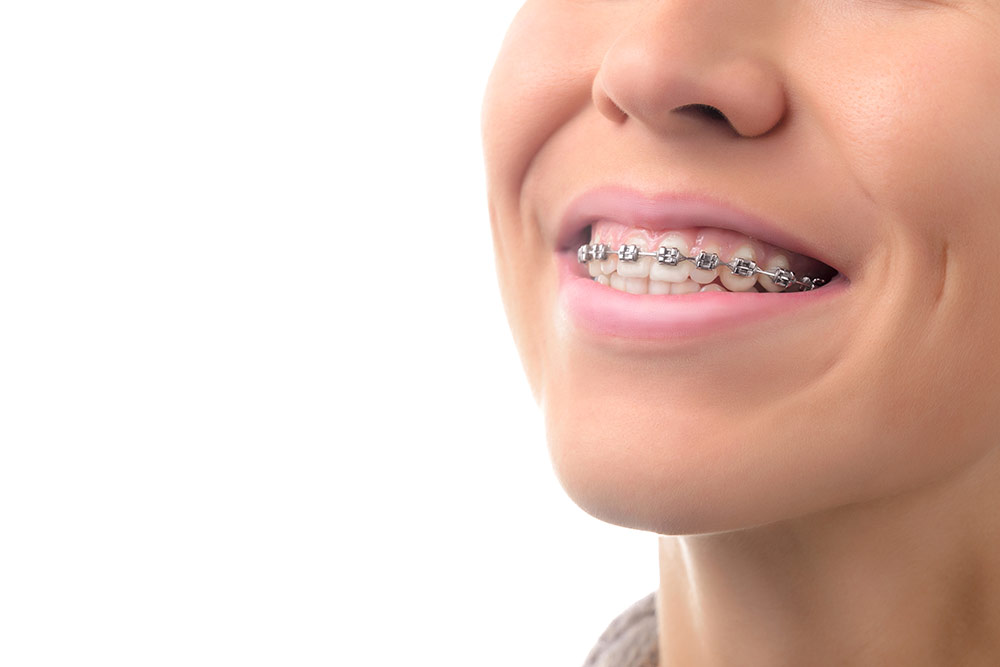
Braces can fix most dental underbites and many mild to moderate skeletal ones. They move the upper teeth forward and the lower teeth back, with small elastics (rubber bands) hooked between the top and bottom braces to pull the bite into place. Treatment runs about 18 to 30 months, depending on severity, followed by a retainer.
The elastics are the part people underestimate. Each band stretches from a hook on an upper back tooth to a hook on a lower front tooth, or the reverse, depending on the direction the bite needs to move. Worn around the clock, that gentle, constant pull does what the brackets alone can’t. It’s also where patients make or break their results. Skip the elastics for a few weeks, and progress stalls. Every hour counts.
Traditional metal braces handle this kind of correction especially well, since the brackets give the elastics a strong anchor. What braces can’t do is change the size of a jaw that has finished growing. That’s the line between a braces-only case and one that needs surgical help.
Wondering what this means for your child? A free consultation with Dr. Andy gives you a straight answer and the options that fit, with no pressure to start. Request your free consultation
Can Invisalign Fix an Underbite?
Invisalign can fix mild to moderate dental underbites. The aligner trays shift the teeth in small stages, and many underbite cases add elastics that attach to the trays, just like with braces. It’s a good fit for teens and adults who want a less visible option. For a significant skeletal underbite, though, aligners aren’t the right tool.
The advantage is daily life. You can take the trays out to eat and brush normally. And there are no brackets in work meetings or senior photos. The tradeoff is discipline. Aligners only move teeth while they’re in your mouth, so they need to be worn about 22 hours a day.
We offer both, so the recommendation comes down to what your bite needs rather than which system we happen to prefer. If you’re curious about the aligner route, Invisalign clear aligners are worth asking about at your consultation.
How Are Underbites Treated in Children?
Children have a big advantage. Their jaws are still growing, so an orthodontist can guide that growth instead of only moving teeth. That’s why the AAO recommends a first orthodontic checkup by age 7. An underbite caught early can usually be corrected without surgery ever entering the conversation.
Two appliances do most of this work. A palatal expander sits against the roof of the mouth and gradually widens the upper jaw, giving the upper teeth room to move forward. A reverse-pull facemask is worn at home in the evening and overnight, and gently encourages the upper jaw to grow forward. It works best before about age 10, while the upper jaw responds most to that pull.
This is the first stage of what’s called two-phase treatment. Phase one corrects the jaw relationship while the child is growing. Phase two, with braces, fine-tunes the permanent teeth a few years later.
Dr. Andy is candid about timing with parents. Sometimes the right move is to start now. Sometimes it’s to watch and wait until the child is ready. He’ll tell you which one your child needs, and he won’t recommend treatment that isn’t necessary.
When Is Surgery Needed to Fix an Underbite?
Jaw surgery is reserved for severe skeletal underbites in patients whose jaws have stopped growing, which means the late teens or adulthood. An oral surgeon repositions the jaw, while the orthodontist straightens the teeth with braces before and after. Most underbites caught in childhood never get to this point.
The surgery itself is called orthognathic surgery. It sounds intimidating, and it’s a real commitment, but it’s also a well-established procedure with dependable results for the cases that truly need it. Braces go on about a year beforehand to line the teeth up with where the jaw will be. They stay on for several months afterward to settle the bite.
For adults, surgery isn’t automatic. Plenty of adult underbites are dental or only mildly skeletal, and braces or aligners handle them fine. You won’t know until someone looks.
How Do I Know Which Underbite Treatment Is Right?
It starts with a diagnosis. An orthodontic exam with X-rays and bite records shows whether an underbite is dental or skeletal (or a mix) and how severe it is. Age matters too. The same bite gets a different plan at 8 than at 28.
That’s the kind of evaluation Dr. Andy does every day. He’s a licensed orthodontic specialist, not a general dentist offering braces on the side, and orthodontics is all our practice does. We see patients of every age from Parma and across the greater Cleveland area.
At the visit, you’ll learn what’s causing the underbite and which options make sense for you or your child. You’ll also get a realistic timeline for how long treatment would take.
Not sure if it’s time for braces? Let’s take a look, free.
If you’re in Parma or anywhere around Cleveland and your child’s bottom teeth are sitting in front of the top ones, or you’ve wondered about your own bite for years, a quick exam will tell you exactly what you’re working with.
Book a complimentary consultation with Dr. Andy. You’ll get a straightforward read on the underbite and the options that fit, with no cost and no pressure to start. Request your free consultation and we’ll reach out to find a time that works around school and activities. Prefer to talk now? Call 440.842.8015.
- A licensed orthodontic specialist, not a general dentist
- Straight answers: treatment only when it’s actually needed
- Every option, from clear aligners to braces, on a schedule that fits
